Droppings form a narrow line
A concentrated strip below a parapet, sign, or beam usually points to a defined landing surface above.
Phoenix metro bird control
Protect narrow landing surfaces with complete coverage sized for the ledge and level of bird pressure.
Bird Spikes
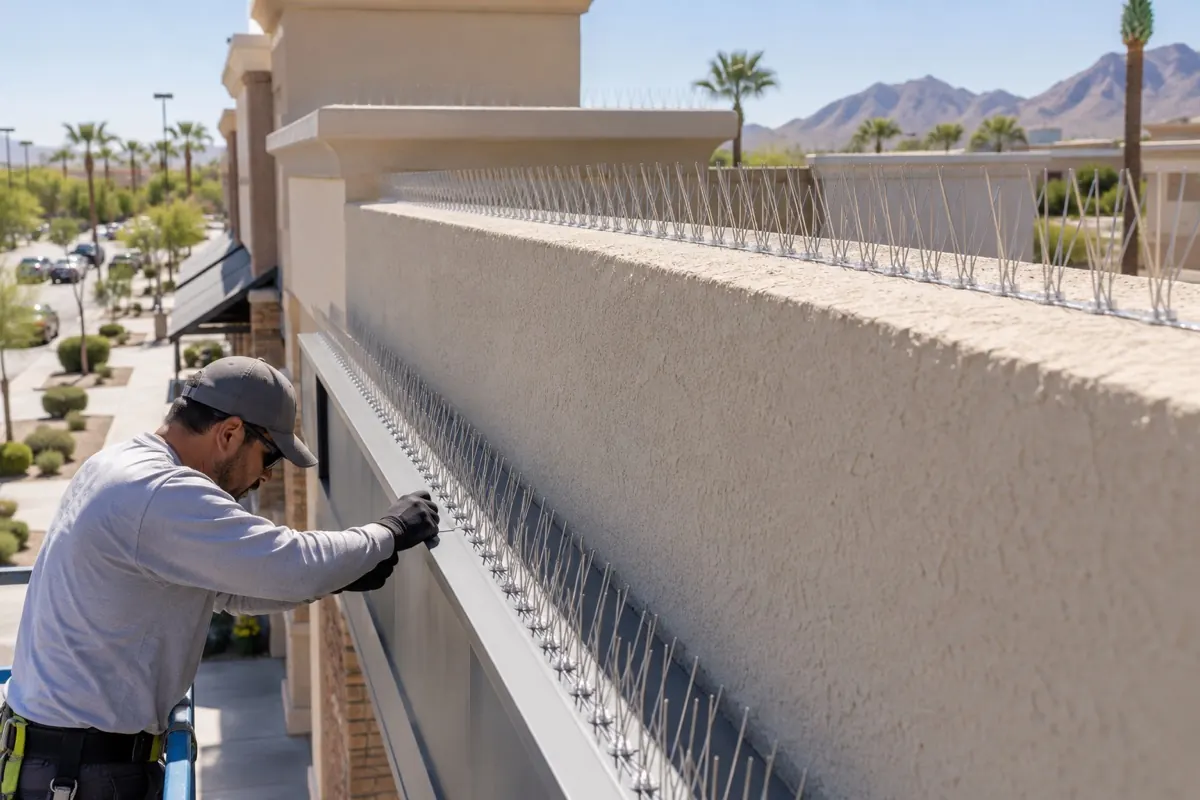
If droppings collect in a straight line below a ledge, sign, roof edge, or beam, birds are probably using that surface as a landing spot. Bird spikes can work well when the surface is right and the coverage is complete. Other bird problems may need mesh, netting, wire, or fitted exclusion instead.
What to look for
A concentrated strip below a parapet, sign, or beam usually points to a defined landing surface above.
A repeated line of birds suggests the full width and length of that ledge needs evaluation.
Spikes can be useful when the source is a suitable ledge rather than an open cavity or broad nesting area.
Birds often exploit uncovered ends, inside corners, or space behind a row that was too narrow for the ledge.
Recommended approach
They are a surface-management tool, not a solution for every bird problem. Row count, profile, attachment, and edge coverage matter because a narrow strip on a wide ledge can leave plenty of room behind it.
Measure usable width, inside corners, returns, and obstructions before choosing a spike profile.
Protect the complete area birds use, including ends and spaces behind the visible edge.
Remove loose material and prepare the substrate so the attachment can hold.
Keep rows straight and deliberate on customer-facing signs, parapets, and architectural details.
Fit and limitations
Process
Make sure the ledge—not a nearby cavity—is creating the mess.
Choose the row count and profile for the usable depth.
Clean the attachment path and secure straight, continuous coverage.
Close end gaps, corners, and adjacent unprotected ledges.
What affects scope
Related services
Pigeon control for recurring roof, patio, ledge, and solar-panel problems
View serviceHumane bird deterrents chosen for the surface, access, and way birds use the property
View serviceCleanup for bird droppings, nest debris, feathers, odor, and staining
View serviceService area
Bird Spikes FAQs
Properly installed spikes are intended to make a landing surface uncomfortable or unavailable, not to trap birds. They still need correct spacing and maintenance.
They fit defined ledges, beams, signs, parapets, and similar landing strips where complete coverage can remove standing room.
Common causes include uncovered ends, a row that is too narrow, weak attachment, debris buildup, or a nearby nesting gap that spikes do not address.
Netting is usually considered when birds are entering a large overhead volume such as a canopy, dock, courtyard, or parking structure rather than landing on one narrow ledge.
Tell us which ledge, sign, beam, or parapet birds are landing on and how wide it is.