Birds sit beside the existing deterrent
The coverage may be too narrow, incomplete, or placed on the wrong surface.
Phoenix metro bird control
Choose mesh, spikes, netting, wire, or fitted exclusion based on bird pressure, surface, access, and visibility.
Bird Deterrents
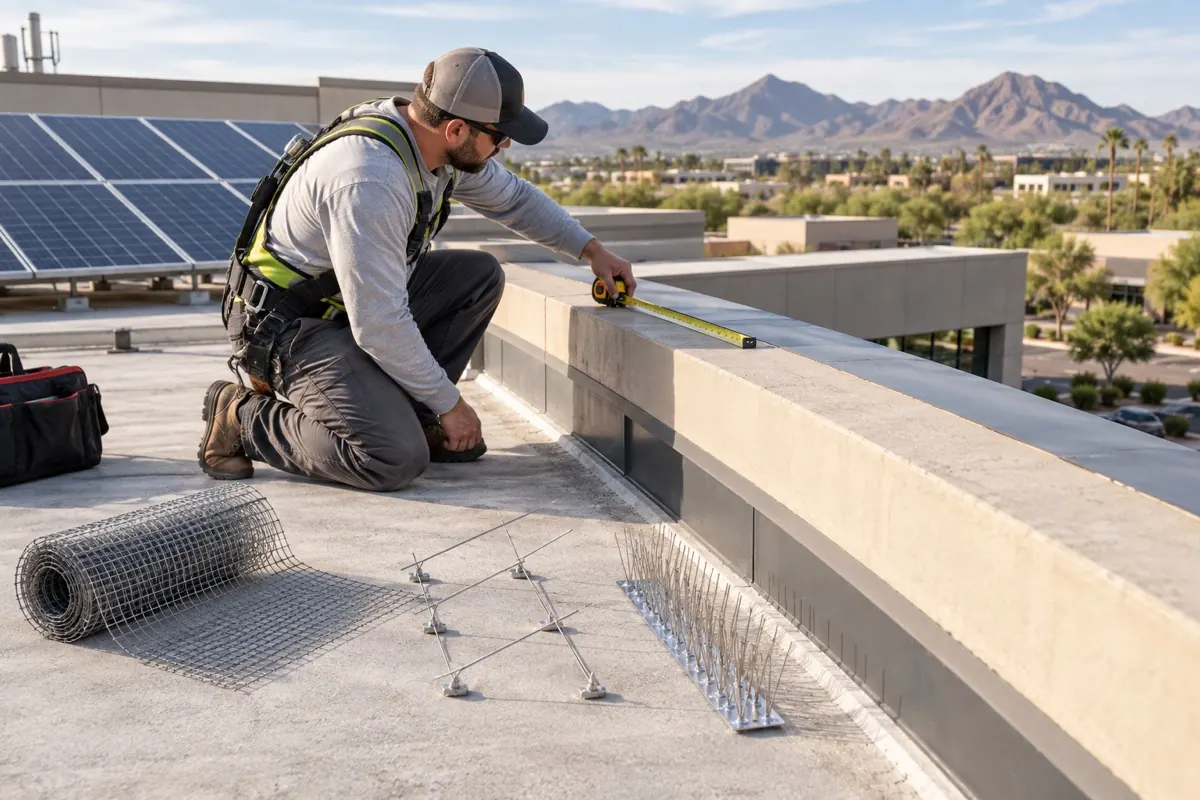
Bird deterrents work best when they solve the exact behavior you are seeing. Birds landing on a ledge, nesting under solar panels, flying into a canopy, or entering a gap all need different treatment. We match products to the problem instead of forcing one generic solution everywhere.
What to look for
The coverage may be too narrow, incomplete, or placed on the wrong surface.
Treating one ledge without mapping adjacent rooflines and gaps can simply redistribute the pressure.
Birds can become accustomed to stationary scare products when the desirable roost remains available.
Landing, nesting, and flying into a covered space usually require different methods within one plan.
Recommended approach
The same pigeon may use a narrow sign edge, broad roof parapet, and protected solar cavity in one day. A deterrent plan matches each behavior to the smallest durable method that removes that opportunity.
Best for closing defined perimeters, gaps, and protected cavities.
Useful on suitable ledges when width, row count, and complete coverage are addressed.
Creates separation across larger overhead volumes such as docks, canopies, and courtyards.
Use different methods where a property has both nesting access and separate landing surfaces.
Fit and limitations
Process
Separate landing, roosting, nesting, entry, and overhead flight.
Review width, perimeter, opening size, attachment, and maintenance needs.
Balance coverage, visibility, access, and durability for that location.
Check where birds may move when the primary surface becomes unavailable.
What affects scope
Related services
Bird-spike installation for suitable ledges, signs, beams, and parapets
View serviceBird netting for canopies, loading docks, courtyards, and other large overhead spaces
View serviceBird exclusion for gaps, eaves, signs, beams, and protected nesting areas
View servicePigeon control for recurring roof, patio, ledge, and solar-panel problems
View serviceService area
Bird Deterrents FAQs
The best fit depends on whether birds are landing, nesting, entering, or flying into a space. Surface width, access, appearance, and pressure level narrow the choice.
They may change behavior temporarily in some settings, but birds can become accustomed when food, shelter, or a preferred roost remains available.
Yes. A property may need mesh beneath panels, spikes on a sign, and fitted exclusion at a roof gap because each area supports a different behavior.
Birds look for the easiest untreated section. Ends, corners, rear ledge space, and transitions often determine whether an installation works.
Tell us whether birds are landing, nesting, entering an opening, or flying into a covered space.